How to deal with Monero's ~20-minute funds lock
First, I want to say that I'm very happy to be a node in the Monero network, and I rely on the untraceability Monero offers to send money to family and friends living in less friendly places. It's truly digital cash, in the strictest sense, but it isn't without problems that we'll need to solve for smoother adoption in the future. Some of these problems are technical, others are philosophical, and all of them need work from us. Today I was thinking about how to tackle one inconvenience: Monero being locked for about 20 minutes (10 blocks).
Let's say you have some Monero, and when you open your wallet you see a balance of 6.218 XMR. You don't necessarily know how many coins (outputs) make up that total. Is it one single coin, or a few? How many transactions have you made? How many have you received? This matters for a few reasons. Imagine you want to buy some merchandise for 5 XMR, and then pay 0.99 XMR for a pay-per-view so you can watch your favourite team play live. Here are two possible scenarios.
| Coins in the wallet | Paying 5 XMR | Then paying 0.99 XMR | |
|---|---|---|---|
| One coin | one coin of 6.218 XMR | spends the only coin; 1.218 XMR comes back as change, locked for 10 blocks | wait about 20 minutes |
| Several coins | six coins of 1 XMR and one of 0.218 XMR | spends five 1 XMR coins, plus the 0.218 XMR coin for the fee | pay at once with the 1 XMR coin left |
If your wallet holds one single coin that you withdrew from an exchange, then after you send the first 5 XMR you'll need to wait around twenty minutes to get your change back, since it's a newly formed coin of 1.218 XMR, and only then can you spend it. You might miss twenty minutes of the game, or more if blocks are mined slowly. That can be frustrating for anyone who wants, for whatever reason, to make a few transactions in quick succession.
If instead your wallet holds six coins of 1 XMR and one of 0.218 XMR, you'll spend five of the 1 XMR coins, plus the 0.218 XMR coin to cover the fee, and you'll still have 1 XMR available: a separate coin, untouched by the lock, that you can use right away to pay for the game.
This ten-block wait before a coin unlocks is enforced by the Monero network as a consensus rule, which means you can't write your own wallet code to unlock outputs sooner: the network will reject those transactions. It might seem arbitrary, but it's an important part of Monero's privacy toolset. If you could bypass the lock, your outputs wouldn't have enough time to be used properly as decoys in other transactions' ring signatures, which would give blockchain analysis some insight in certain cases. With the enforced 10-block lock, that's a non-issue.
What can be done
What can be done to improve the user experience here? There are a couple of things.
Show users how many coins they have
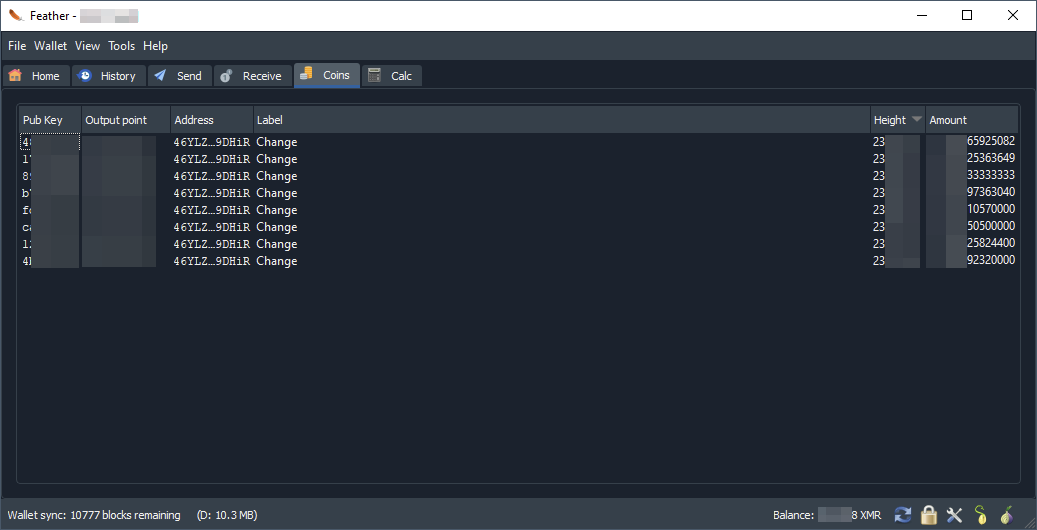
Wallet developers need a way to show users, graphically, how many coins they hold and what each one is worth. A simple menu option listing the coins you currently hold is enough. Feather Wallet already does this, and I truly appreciate the feature: it shows how many coins you have, their amounts, and the subaddresses they're linked to. It's useful to know how many outputs you hold if you want to make several quick transactions, or if you simply want to consolidate many coins into one bigger coin. Having this information is a real improvement in user experience, and it shouldn't be hard for other wallets to add.
Make it easier (or at least possible) to pay several addresses in one transaction
Another solution is easy access to sending a single transaction to several addresses. The Monero network supports transactions to up to sixteen addresses, which means that even with one big coin of 100 XMR you can pay up to sixteen people in one go. For a long time this was only possible from the command-line wallet (CLI). As far as I know, the graphical wallet (GUI) still doesn't offer it. Feather Wallet does, although it's a bit hidden, and as far as I know it's the only graphical wallet that supports it, which again I really appreciate. Every other wallet, mobile ones included, lacks the feature. I think it's one of those things that isn't popular simply because people don't know it can be done. It could help anyone with a single output who needs to make several payments at once, provided they already have the list of addresses and amounts, of course.
Wallet developers carry a big responsibility for education, because their software is what shapes behaviour. If more wallets supported these features, along with material explaining how to use them, more people would learn about Monero and its properties, and could make full use of the benefits this currency and its network provide.